Hesheng Cable
Leave Your Message

Why Choose Four Core Wire for Global Sourcing?

Global sourcing decisions often begin with a simple question: can the cable deliver stable performance across different operating conditions? Four Core Wire can be a practical answer for equipment requiring multiple conductors in one organized cable. Its four internal cores may support power distribution, control signals, grounding, or other specified functions. The exact arrangement depends on the application.

A well-selected Four Core Wire can simplify installation and reduce cable clutter. In a control cabinet, four clearly identified cores make termination faster and troubleshooting more manageable. Color coding, conductor size, insulation material, temperature rating, and voltage capacity all deserve careful review. Small details matter. Experienced sourcing teams usually compare technical drawings, sample measurements, factory test reports, and batch traceability records before placing larger orders.

Global procurement also requires disciplined supplier evaluation. Reliable manufacturers should explain conductor construction, insulation standards, production tolerances, and inspection methods. Independent testing may help confirm electrical resistance, tensile strength, flame performance, and environmental suitability. Certifications can differ by destination market, so buyers should verify current requirements with qualified compliance professionals. A certificate alone does not guarantee consistent quality.

Cost remains important, but the lowest quotation may create hidden expenses through delays, rejected batches, or difficult installation. I have seen specifications appear complete while omitting bend radius or sheath requirements. That gap deserves attention. Four Core Wire is not automatically the best choice for every project. Engineers should assess load, distance, movement, moisture, heat, and maintenance needs before approving a supplier. With clear documentation and realistic testing, this cable format can support safer, more efficient global sourcing decisions.
Why Choose Four Core Wire for Global Sourcing?

Four-Core Wire Defined: Construction, Functions, and IEC 60228 Conductor Classes

Four-Core Wire Defined: Construction, Functions, and IEC 60228 Conductor Classes

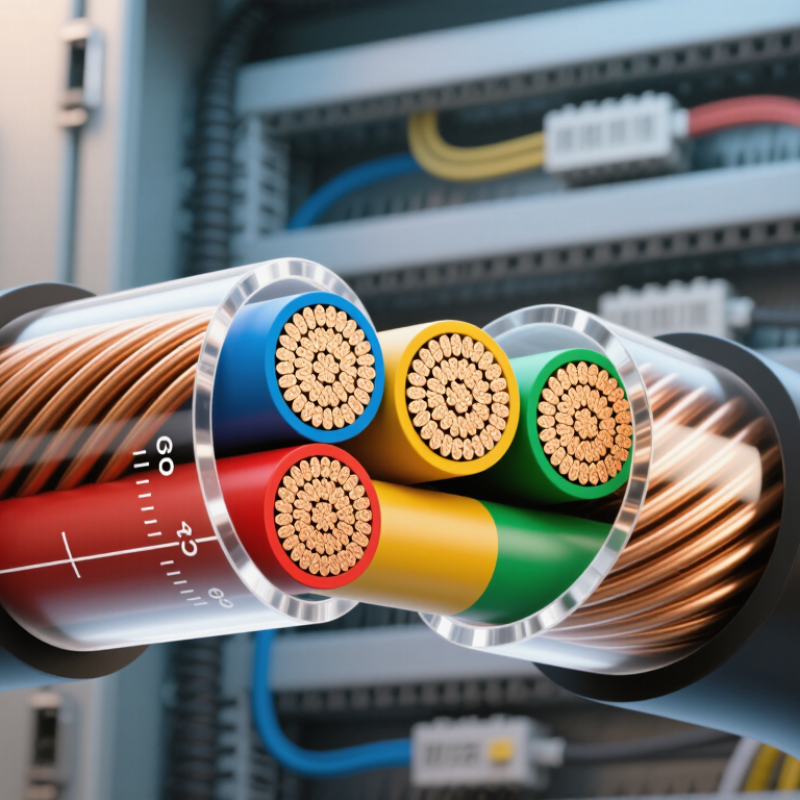
Four-core wire contains four separately insulated conductors inside one cable assembly. Depending on the circuit, they may carry three-phase power and neutral. Another design uses three power conductors and a protective earth. The arrangement must be confirmed from the technical drawing. Never assume the fourth core has one fixed purpose.

The conductor class affects installation and performance. IEC 60228 Class 1 uses solid conductors with a fixed shape. Class 2 uses stranded conductors, offering better handling during installation. Class 5 is flexible and suits moving equipment or tight bends. Class 6 is even more flexible, but it can cost more and needs careful termination. These classes describe conductor construction, not the complete cable design.

In global sourcing, I review conductor material, cross-sectional area, insulation type, voltage rating, temperature range, and outer diameter. A sample cut can reveal uneven insulation or poorly compacted strands. It is a small check, but useful. Test reports should identify resistance, dimensions, and the stated IEC 60228 class. Suppliers should also provide clear drawings and consistent batch records. A flexible cable is not automatically the best choice. It may simplify routing, yet require stronger strain relief. I have seen specifications focus on price while overlooking bend radius and terminal compatibility. That mistake can create delays after delivery. Four-core wire works well when its construction matches the actual circuit, installation method, and equipment movement.
Voltage, Current, and Insulation Requirements Under IEC 60502-1

Global sourcing often starts with a simple question: why choose four-core wire? The answer depends on voltage, current, and insulation conditions, not appearance. The IEA Electricity 2024 report forecasts average global electricity demand growth of 3.2% annually from 2024 to 2026. That growth increases the need for dependable low-voltage distribution cables.

IEC 60502-1 covers power cables with extruded insulation for rated voltages from 1 kV to 3 kV. Buyers should confirm the exact U0/U rating before ordering. A four-core design may serve three-phase power with a neutral, or another approved arrangement defined by the project. It is not automatically a protective-earth solution. That detail matters.

Current capacity must match conductor material, cross-sectional area, installation method, ambient temperature, and cable grouping. IEC-based selection also requires attention to insulation limits. PVC insulation commonly allows a 70°C maximum conductor temperature, while XLPE commonly allows 90°C under normal operation. These figures affect ampacity and service life.

In practical sourcing, I request routine-test records, type-test evidence, conductor resistance results, and dimensional checks. I also compare the declared current rating with the actual tray, conduit, or buried installation. A cable can pass a catalog review and still underperform in a crowded tray. I have seen this shortcut create unnecessary heat. The lesson is uncomfortable: four cores offer useful system flexibility, but only when voltage class and thermal assumptions are verified before shipment.

Global Sourcing Benefits: Installation Efficiency, Safety, and Material Use

Why Choose Four Core Wire for Global Sourcing?

Four-core wire can simplify installations when one cable carries power, control, neutral, or grounding functions. Fewer cable runs mean fewer junctions, less routing work, and faster termination inside crowded panels. Installers can label each core clearly before pulling the cable through conduit. This reduces confusion during commissioning and maintenance. It also saves space in trays and reduces the amount of insulation and protective material required. However, four-core construction is not a universal answer.

Safety depends on correct design, not conductor count alone. Engineers should check current capacity, insulation temperature, voltage rating, bending radius, and grounding requirements. A cable may look suitable but still overheat under continuous load. Poor separation between power and signal cores can also create interference. Material sourcing should include batch traceability, dimensional checks, conductor resistance tests, and documented inspection results. These details support reliable purchasing across different markets. Still, specifications can be misunderstood when drawings lack clear symbols or operating conditions.

Tips: Confirm the core function before ordering. Request test reports and sample measurements. Compare installed length, not only unit price. Leave enough bending room near terminals. Review the design with an experienced electrician. Small mistakes remain expensive.

Why Choose Four Core Wire for Global Sourcing? - Global Sourcing Benefits: Installation Efficiency, Safety, and Material Use
Evaluation Dimension Four-Core Wire Configuration Practical Benefit for Global Sourcing Reference Data or Calculation Important Specification Check
Typical power arrangement Commonly used as three phase conductors plus a protective earth conductor, or as three phase conductors plus a neutral conductor. Supports compact distribution designs where the electrical system requires four functional conductors. Four insulated cores provide four independent current-carrying or protective paths, depending on the selected configuration. Confirm whether the fourth core is required as neutral or protective earth before ordering.
Installation efficiency One jacketed cable replaces multiple separately routed single-core cables in suitable applications. Reduces cable handling, routing coordination, and termination steps during installation. One four-core cable is installed as one cable route, while an equivalent four-conductor single-core arrangement requires four separately managed cables. Actual labor savings depend on cable diameter, bend radius, tray layout, termination method, and local installation rules.
Termination workload Four cores are identified and terminated within one cable assembly. Can simplify labeling, cable entry, and inspection compared with separately routed conductors. A four-core cable has four conductor ends at each termination point, or eight conductor ends for a complete two-ended run. Use approved glands, lugs, ferrules, and torque values suitable for the conductor material and cross-sectional area.
Material use: copper cross-sectional area For four copper cores of the same size, total copper cross-sectional area equals four times the area of one core. Provides a transparent basis for comparing conductor material before insulation and sheath are considered. Example: 4 × 4 mm² cores = 16 mm² total copper cross-sectional area. Conductor size must be selected by current, voltage drop, short-circuit withstand, installation method, and ambient conditions.
Material comparison with a five-core cable A four-core cable uses one fewer conductor than a same-size five-core cable. Where a neutral is not required, the design may reduce conductor material and cable diameter. At 4 mm² per core: four-core copper area = 16 mm²; five-core copper area = 20 mm². The four-core design uses 20% less conductor cross-sectional area than the five-core design. This comparison is valid only when both cable designs have the same conductor size and the same electrical function is not lost.
Illustrative copper volume for a 100 m run Four cores × 4 mm² × 100 m. Allows procurement teams to estimate conductor material independently from the finished cable construction. Four-core volume = 1,600,000 mm³ = 1,600 cm³. Using copper density of approximately 8.96 g/cm³, the copper mass is approximately 14.3 kg, excluding insulation and sheath. Finished cable mass will be higher because it includes insulation, fillers, screens, armour, sheath, and manufacturing tolerances.
Electrical safety Can provide a dedicated protective earth core when designed as a three-phase-plus-earth cable. Reduces reliance on improvised grounding methods and supports a defined protective conductor path. Protective conductor sizing and continuity must comply with the applicable installation standard and fault-protection design. A four-core cable is not automatically safer; safety depends on correct conductor identification, sizing, bonding, and protection.
Phase balance and neutral requirement Suitable for balanced three-phase loads when no neutral current path is required, subject to system design. May avoid an unnecessary neutral core in dedicated three-phase equipment circuits. In a balanced three-phase system, the vector sum of phase currents is approximately zero, so neutral current can be minimal or absent under designed conditions. If single-phase loads, control circuits, or significant harmonic currents require a neutral, specify a five-core cable or another compliant arrangement.
Voltage-drop planning All cores share the same cable construction, but voltage drop still depends on conductor resistance, current, length, and power factor. Enables standardized cable selection across projects when operating conditions are comparable. For a resistive approximation, voltage drop increases with conductor resistance and route length. Copper resistance rises as conductor cross-sectional area decreases. Calculate voltage drop using the applicable AC cable data, installation length, load current, power factor, and local code limits.
International procurement consistency Can be specified using internationally recognized conductor area, voltage rating, insulation type, temperature rating, and test requirements. Creates a clearer technical comparison among suppliers without relying on brand-specific descriptions. IEC 60228 classifies conductor construction and nominal cross-sectional areas; IEC 60364 provides principles for low-voltage electrical installations. Request test certificates, marking details, conductor class, rated voltage, flame performance, and applicable regional approvals.
Handling and storage One cable drum or coil contains all four conductors in a protected assembly. Can simplify receiving inspection, inventory counting, and route allocation. Procurement can track one cable part specification by length, conductor size, voltage rating, and sheath construction. Confirm minimum bending radius, drum dimensions, maximum pulling tension, storage temperature, and shelf-life requirements.
Best-fit application Fixed power distribution, motor feeders, industrial equipment, and other circuits requiring four defined conductors. Offers a balanced combination of installation simplicity, controlled conductor identification, and material efficiency. Best results occur when the four-core arrangement matches the load, earthing system, protection scheme, and local electrical regulations. Do not substitute four-core for five-core solely to reduce cost; verify the complete circuit design first.
Technical note: The material calculations use equal-size copper conductors and exclude insulation, sheath, armour, fillers, screens, and manufacturing tolerances. Final cable selection must be verified against the applicable electrical code, installation method, load characteristics, environmental conditions, and required certifications.

Comparing Copper and Aluminium Conductors by Weight, Cost, and Conductivity

Why Choose Four Core Wire for Global Sourcing?

Comparing copper and aluminium starts with physics, not habit. Copper has a density of about 8.96 g/cm³, while aluminium measures about 2.70 g/cm³. Aluminium therefore weighs roughly one-third as much for the same volume. Copper offers about 100% IACS conductivity. Aluminium provides approximately 61% at 20°C, according to IEC-based engineering references. A four-core aluminium cable can reduce transport weight and handling effort. However, engineers usually need a larger aluminium cross-section to match copper resistance. More space may be required inside trays, glands, and terminals.

Cost is less predictable than many purchasing teams expect. Copper prices react strongly to mine supply, manufacturing demand, and exchange rates. The USGS Mineral Commodity Summaries 2025 reports around 22 million metric tons of global copper mine production in 2024. The International Aluminium Institute reports global primary aluminium output above 70 million tonnes in 2024. These figures suggest broader aluminium availability, but availability does not guarantee lower delivered cost. Freight, alloy grade, insulation, and termination hardware can change the result. A low material quote may become expensive after installation. That mistake is common.

Tips: Compare complete installed cost, not metal price alone. Request resistance data, temperature ratings, conductor class, and test certificates. Check bending space before selecting four-core aluminium wire. Aluminium connections also need careful preparation and compatible terminals. A spreadsheet can miss these details. Recheck it with a site-based engineer.

Why Choose Four-Core Wire for Global Sourcing?

Copper and aluminium conductor comparison by weight, indicative raw-material cost, and conductivity

The comparison uses copper as the 100-point reference. Conductivity is shown for the same conductor cross-sectional area, while weight and cost are calculated for approximately equal electrical conductance. Aluminium provides about 61% of copper’s conductivity at the same area, but requires a larger cross-section; its equivalent-conductance weight is approximately 51% of copper’s. The cost index is an indicative raw-material benchmark based on copper at US$9.50/kg and aluminium at US$2.50/kg. Actual four-core cable performance and pricing also depend on conductor size, insulation, manufacturing, transport, and applicable standards.

Supplier Evaluation: RoHS Compliance, IEC 60332 Testing, and Quality Traceability

Four-core wire can simplify global sourcing, but only when supplier evaluation goes beyond price and delivery dates. RoHS documentation should identify restricted substances, test methods, and the exact cable construction. Generic declarations create uncertainty. Ask for current reports.

IEC 60332 testing is equally important when flame performance matters in equipment or building applications. A credible supplier should provide the applicable test standard, sample description, laboratory details, and results.

A pass report is useful, but it is not the whole truth. Production conditions can change after testing. Request evidence that tested materials match current production lots.

Quality traceability connects the finished cable to its manufacturing history. Lot numbers should link to conductor materials, insulation batches, operator records, inspection results, and shipment dates. During supplier reviews, I would also check how nonconforming products are isolated. A polished audit folder may hide weak shop-floor control. That gap deserves attention.

One practical check is to select a carton at random and trace it backward. The process should reach raw-material records without missing links. It should also move forward to inspection and delivery data. Some suppliers perform well but record information inconsistently. This is a real sourcing risk, not a minor paperwork issue. A clear traceability process supports faster investigations and more dependable purchasing decisions.