Hesheng Cable

Leave Your Message
China’s crane cable market includes manufacturers and suppliers serving ports, steel mills, construction sites, shipyards, and industrial workshops. Their products may include festoon cables, pendant cables, flat reeling cables, control cables, and power cables for demanding lifting systems. Each application requires more than a strong outer jacket. Bending radius, conductor flexibility, oil resistance, flame performance, temperature range, and torsion resistance can determine service life.
Small details matter.
A cable passing repeatedly over a drum may develop abrasion near the first guide point. A festoon system may fail when the trolley spacing, cable weight, and travel speed are poorly matched. Experienced purchasing teams therefore review drawings, load conditions, installation photos, test reports, and replacement history before selecting a supplier. They also verify manufacturing consistency, material traceability, quality-control procedures, and compliance with relevant international requirements.
Don Sayenga, a respected wire-rope historian and consultant, has emphasized, “Wire rope is a machine.” His observation also suits Crane Cable selection: the cable works as part of a complete moving system, not as an isolated product. A reliable supplier should explain that relationship clearly.
Still, no supplier ranking is perfect. Factory capability can change, and attractive specifications may hide weak technical support. Buyers should compare evidence, not promises. Sample testing, factory communication, and documented inspection remain essential. This guide examines China’s leading Crane Cable manufacturers and suppliers through product range, engineering experience, quality practices, customization ability, and after-sales reliability. The goal is practical judgment, not a polished list without questions.
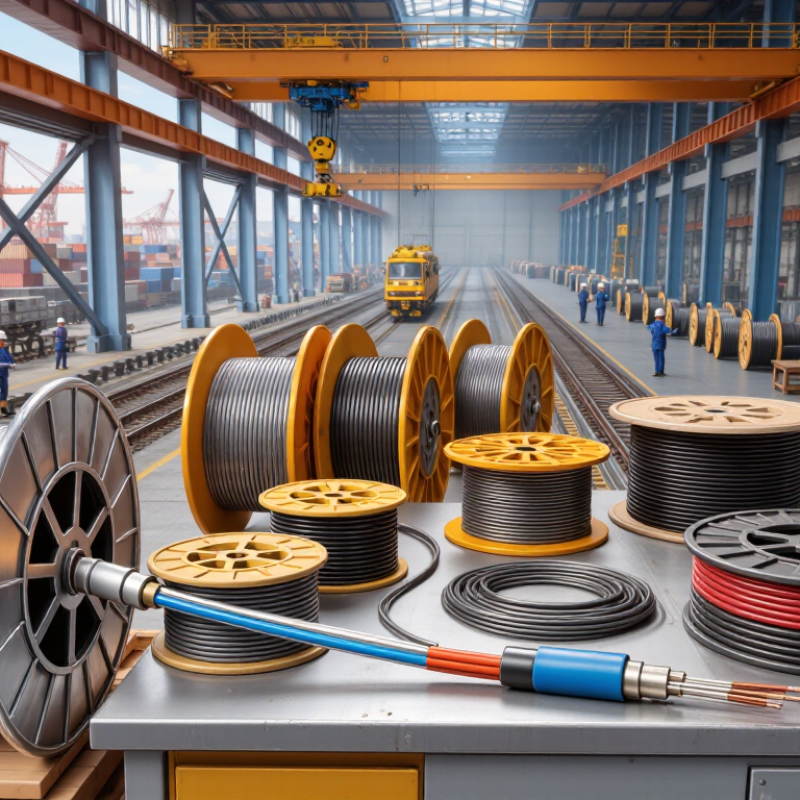
China’s crane industry uses several cable types for ports, factories, construction sites, and steel mills. Galvanized steel wire rope remains common because its zinc coating slows corrosion in humid yards. Rotation-resistant rope helps tall cranes keep suspended loads stable. Compacted strands provide higher strength and smoother drum contact. Stainless steel rope suits lighter lifting systems and corrosive indoor areas, but its higher price limits wider use.
Fortune Business Insights valued the global wire rope market at about USD 9.26 billion in 2023. Its report expects continued growth through 2032, driven partly by construction and material handling. Synthetic fiber ropes are also gaining attention in China. They weigh less and reduce manual handling risks, although abrasion and heat can shorten service life. Electric hoist systems use flexible power, control, and festoon cables. These cables need strong bending resistance, especially along repeated trolley travel. In practice, selection is not always perfect. Some buyers still choose by breaking load alone.
Tips: Check rope diameter, construction, lay direction, bending cycles, and working temperature. Match the cable with the sheave and drum. Inspect broken wires, flattening, corrosion, and birdcaging before each shift. ISO 4309 recommends systematic inspection and discard criteria for crane wire ropes. Keep records. A low-cost rope may become expensive after frequent replacement.
| Crane Cable Type | Typical Construction | Core Type | Typical Nominal Diameter | Key Characteristics | Common Crane Applications | Typical Strength Grade | Relevant Standards |
|---|---|---|---|---|---|---|---|
| General-Purpose 6×19 Wire Rope | 6 strands with approximately 19 wires per strand | Fiber core or independent wire rope core | 8–32 mm | Balanced performance Good abrasion resistance Moderate flexibility | Light and medium-duty overhead cranes, gantry cranes, hoists, and general lifting equipment | 1,570–1,960 MPa | GB/T 20118; ISO 2408 |
| Flexible 6×37 Wire Rope | 6 strands with approximately 37 wires per strand | Fiber core or steel core | 8–36 mm | High flexibility Small bending-radius capability Good sheave conformity | Hoisting mechanisms with frequent reeving, grab cranes, port cranes, and equipment using multiple sheaves | 1,570–1,960 MPa | GB/T 20118; ISO 2408 |
| Compacted 6-Strand Wire Rope | Six compacted strands with reduced outer-wire gaps | Independent wire rope core or compacted steel core | 12–40 mm | High metallic area Improved crushing resistance Higher strength-to-diameter ratio | Heavy-duty bridge cranes, steel mills, container handling cranes, and high-load hoisting systems | 1,770–2,160 MPa | GB/T 20118; ISO 2408 |
| Rotation-Resistant 35×7 Rope | Multiple layers of strands arranged to reduce torque and rotation | Steel core | 10–32 mm | Low rotation Good balance under load Suitable for single-part lifts | Mobile crane main hoists, tower cranes, telescopic cranes, and lifting operations where load rotation must be limited | 1,570–1,960 MPa | GB/T 20118; ISO 2408 |
| Rotation-Resistant 19×7 Rope | 19 strands arranged in multiple layers with a compact construction | Steel core | 8–26 mm | Low torque Good flexibility Controlled rotation | Small mobile cranes, tower cranes, personnel lifting systems, and single-line hoisting applications | 1,570–1,960 MPa | GB/T 20118; ISO 2408 |
| Non-Rotating Multi-Layer Rope | Specially balanced multi-layer strand construction | Steel core | 12–38 mm | Very low rotation Suitable for tall lifts Requires correct installation | High-rise construction cranes, deep-shaft lifting, offshore lifting equipment, and long free-hanging loads | 1,770–2,160 MPa | ISO 2408; applicable national specifications |
| Plastic-Coated Steel Wire Rope | Steel wire rope with an external polymer coating | Steel core or fiber core | 6–24 mm steel core diameter | Reduced corrosion exposure Cleaner handling Protective outer layer | Indoor cranes, light lifting systems, corrosive environments, and applications requiring reduced contact damage | Depends on the internal rope construction | Base rope generally specified to GB/T 20118 or ISO 2408 |
| Galvanized Crane Wire Rope | Steel wire rope with zinc-coated wires | Fiber core or steel core | 6–40 mm | Improved corrosion resistance Suitable for outdoor service Requires regular inspection | Port cranes, shipyard cranes, outdoor gantry cranes, coastal lifting equipment, and humid industrial locations | 1,570–1,960 MPa | GB/T 20118; ISO 2408 |
| Stainless Steel Wire Rope | Corrosion-resistant alloy steel wires arranged in standard rope constructions | Fiber core or steel core | 3–16 mm | High corrosion resistance Clean appearance Lower load capacity than carbon steel at equal diameter | Food-processing facilities, chemical plants, architectural lifting systems, and highly corrosive indoor or outdoor locations | Usually 1,570–1,960 MPa, depending on grade | ISO 2408; material grade specified separately |
| Compacted Rotation-Resistant Rope | Compacted multi-layer strands designed for strength and torque control | Steel core | 14–45 mm | High breaking force Low rotation Good resistance to drum crushing | Heavy container cranes, large ship-to-shore cranes, mining hoists, and high-capacity industrial cranes | 1,770–2,160 MPa | GB/T 20118; ISO 2408 |